

Commentary
Liliana Gamboa, Kayly Ober
Source: Getty
By reorganizing federal disaster policy around the rights of displaced people, the United States could unlock additional federal resources, accelerate the rebuilding of lives and livelihoods, and reduce suffering and economic disruption.
This year marks the twenty-eighth anniversary of the UN Guiding Principles on Internal Displacement, an international framework that fundamentally changed how the world understands and responds to the forced movement of people within their own countries. The principles were a novel undertaking in 1998: They provided a systematic definition of internally displaced persons (IDPs), laid out the rights to which they are entitled, and established the obligations of states to protect and assist them. In the decades since, they have proven transformative in dozens of countries.
In the United States, however, federal disaster policy is organized financially (focusing on program eligibility, administrative timelines, and funding appropriations), not around the rights of displaced people nor the state’s obligations to them. As the Brookings-Bern Project on Internal Displacement observed, the U.S. government called the people displaced by Hurricane Katrina “evacuees” rather than IDPs, “perhaps to avoid having to take responsibility for implementing their rights.” Indeed, the word “displacement” has traditionally been reserved for what happens in conflict zones and fragile states. But millions of Americans are displaced by disasters every year, and a significant share of them remain displaced for months or years.
To date, the United States has not reflected the Guiding Principles on Internal Displacement in its disaster law. Several of the principles’ core provisions speak directly to failures in U.S. disaster recovery: the absence of a single accountable authority; the lack of any standard for what recovery means or when displacement has ended; the persistent inequities in who bears the heaviest burden; and the near total exclusion of displaced people from the decisions that shape their own futures.
This article argues that the United States needs to acknowledge its internal displacement crisis, adopt a rights-based framework to address the crisis, and take three concrete steps to begin fulfilling its obligations to people displaced by disasters.
The United States has experienced displacement crises for decades. According to the Internal Displacement Monitoring Centre (IDMC), between 2008 and 2024, approximately 22.3 million people were displaced in the United States due to a range of hazards, including floods, storms, and wildfires.
These numbers are significant but incomplete. IDMC’s estimates primarily capture the number of people who evacuated, not necessarily those who remained displaced for extended periods. They also tell us relatively little about who was displaced and why. For that, different data is needed.
The U.S. Census Bureau’s Household Pulse Survey offers the most detailed onetime snapshot of disaster displacement in U.S. history. The survey, launched in 2020 to track the socioeconomic effects of the COVID-19 pandemic, added a natural disaster module that ran from December 2022 to October 2023. It covered nearly 827,000 respondents’ experiences with hurricanes, floods, fires, and other extreme events.
The findings were striking. Approximately 1.2 to 1.7 percent of respondents reported having been displaced by a natural disaster in 2022 and 2023, representing an average of 3.1 million people per year. In stark contrast, IDMC estimated that 675,000 people were displaced in 2022 and 201,000 in 2023. Hurricanes were the leading driver, according to the Household Pulse Survey, followed by floods, fires, and other hazard types.
Displacement was not evenly distributed. Low-income households (earning under $25,000 annually) reported the highest displacement rates at 2.8 percent. Rates declined steadily at higher income levels, with a secondary spike observed among households earning $200,000 or more (likely reflecting hurricane damage to high-value coastal real estate). Racial disparities were also apparent: Black adults and those identifying as two or more races reported displacement rates of 1.7 to 1.8 percent, compared to 1.2 percent among non-Hispanic White adults. Households with children were displaced at a higher rate (1.6 percent) than those without (1.1 percent).
While most displaced respondents returned home within a month, between 27 and 41 percent were displaced longer. An estimated one million people were unable to return home for more than six months, or did not return at all.
U.S. disaster policy has long been calibrated on the assumption that displacement is a short-term, acute problem.
That last finding is the most consequential. U.S. disaster policy has long been calibrated on the assumption that displacement is a short-term, acute problem; that most people return home quickly; that market mechanisms, such as insurance, are adequate to help displaced people return; and that longer-term needs can be managed through existing programs. However, the Household Pulse Survey suggests that protracted displacement is a routine feature of disaster recovery in the United States.
The Household Pulse Survey data points to a systemic problem of protracted displacement. Three cases across two decades illustrate what that problem looks like on the ground for real people.
When Hurricane Katrina made landfall on August 29, 2005, the subsequent levee failures flooded roughly 80 percent of New Orleans’ housing units and displaced more than 200,000 people—approximately half of the city’s residents. Research five years after the storm documented the deeply unequal nature of that displacement. Using data from the Displaced New Orleans Residents Pilot Survey, Elizabeth Fussell, Narayan Sastry, and Mark VanLandingham found that Black residents returned to the city at a much slower pace than White residents over the fourteen months following the storm. This was partially because Black residents tended to live in areas that experienced greater flooding. Related research found that low-income African American mothers and renters were far less likely to have returned to their pre-Katrina homes eight to eighteen months after the storm than homeowners, often because they had relocated entirely outside the city or the state. Twenty years later, New Orleans has still not recovered its pre-Katrina population, with the loss concentrated heavily among Black residents.
Katrina was, in the language of the Guiding Principles on Internal Displacement, a displacement that lasted far longer than the circumstances required—not because the circumstances were intractable, but because policy choices, market dynamics, and institutional failures made return impossible for tens of thousands of the city’s most vulnerable residents. A 2008 report by Chris Kromm and Sue Sturgis found that U.S. officials failed to live up to global human rights standards at every step of the process: They failed to prevent displacement, protect rights during displacement, and facilitate durable solutions in the recovery period. The U.S. government has never formally acknowledged this finding or applied it to domestic policy reform.
On September 20, 2017, Hurricane Maria made landfall in Puerto Rico as a Category 4 storm, devastating an island already decades into an economic crisis. At the time, Puerto Rico was carrying over $45 billion in debt, including more than $9 billion held by its public utility, the Puerto Rico Electric Power Authority (PREPA), and was mired in decades of structural underinvestment in infrastructure and deferred maintenance. This meant the island was largely unprepared for a large-scale storm such as Maria.
A study commissioned by the Puerto Rican government estimated that 2,975 people died due to the storm. Hurricane Maria also caused the worst electrical blackout in U.S. history, with households going an average of eighty-four days without power, sixty-eight days without water, and forty-one days without cell service.
The displacement that followed was massive and, for many, permanent. Analyses drawing on census data, air travel records, and mobile phone data estimated population losses ranging from 129,000 to 476,000 in the year after Maria. By 2019, Puerto Rico had lost an estimated 4 to 14 percent of its total population, equivalent to the loss from an entire prior decade of economic migration. Many Puerto Ricans migrated to Florida, Pennsylvania, Texas, and New York, where family networks had grown over decades of prior migration.
FEMA’s initial response was also widely criticized as inadequate. One study found that Puerto Rico received less funding in 2017 than other hurricane-affected states, such as Texas (Hurricane Harvey) and Florida (Hurricane Irma). Within nine days of landfall, survivors in Texas and Florida had received about $100 million in Federal Emergency Management Agency (FEMA) assistance, while Puerto Ricans had only received about $6 million. This was despite Maria causing more overall destruction in terms of electricity loss and home damage, according to researchers.
This funding gap most likely reflected logistical challenges, such as widespread electricity outages and difficulties understanding or navigating the bureaucracy, that limited Puerto Ricans’ ability to apply for assistance. At the same time, these challenges cannot be disentangled from deeper structural inequities in how federal recovery resources reach a territory whose residents are citizens but whose government lacks the political representation afforded to states.
While Congress approved $20 billion in Community Development Block Grant Disaster Recovery (CDBG-DR) funds—flexible grants administered by the U.S. Department of Housing and Urban Development (HUD)—for Puerto Rico, the funds were not released promptly and required jumping through extra bureaucratic hoops that were not applied in other states. For example, U.S. President Donald Trump required HUD to appoint a federal financial monitor to oversee the administration of these funds in Puerto Rico. In addition, the island’s main housing reconstruction initiative, the Repair, Reconstruction, or Relocation (R3) Program, did not begin distributing significant assistance until several years after the hurricane. This meant that many people who had lost homes during Maria remained in damaged housing for extended periods, relied on temporary assistance, or migrated to the U.S. mainland.
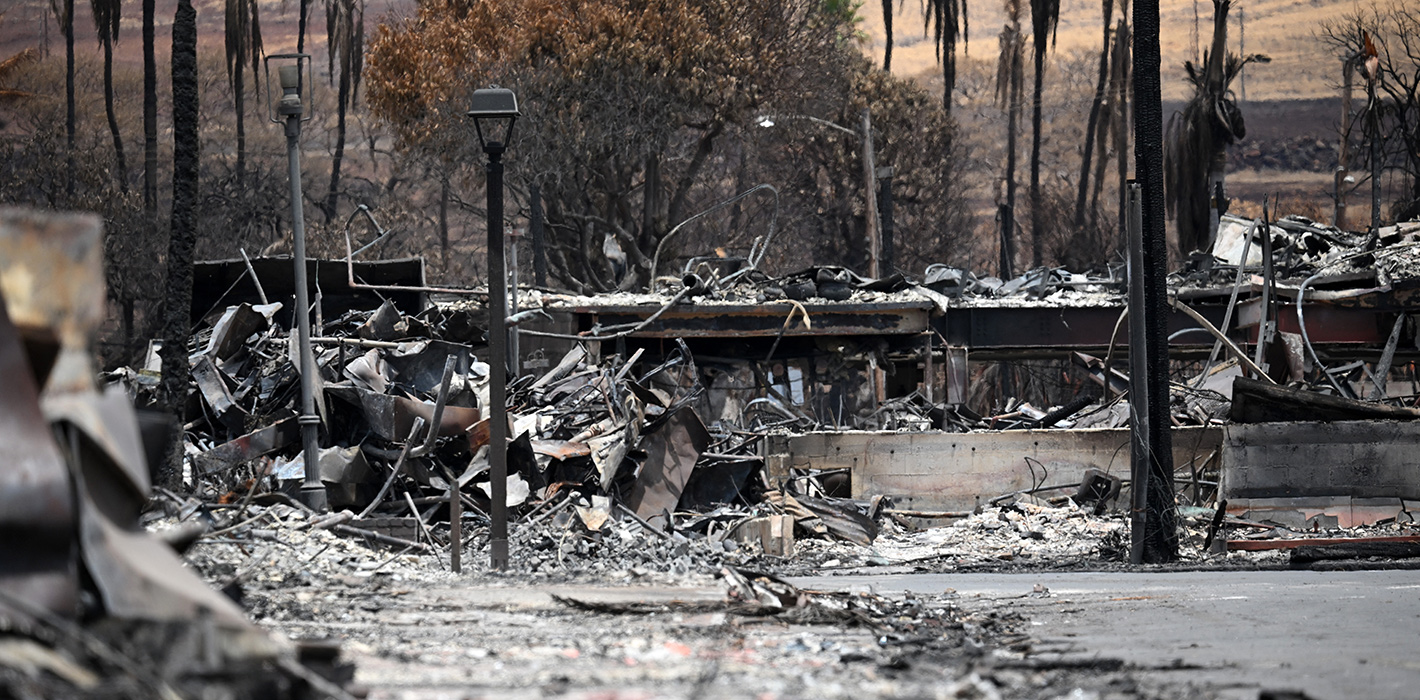
On August 8, 2023, a wildfire driven by hurricane-force winds tore through Lahaina on the Hawaiian island of Maui, killing 115 people, destroying more than 2,200 structures, and displacing the town’s approximately 12,000 residents overnight. It was the deadliest U.S. wildfire in more than a century. Decades of dense, haphazard development in Lahaina’s historic core had produced a built environment with few effective firebreaks. Narrow roads, tightly packed structures, and insufficient buffers turned a fast-moving fire into a nearly inescapable one.
A year after the fire, nearly one-third of all respondents remained in temporary housing and almost twice as many fire-affected households lived in poverty, with nearly 30 percent living below the poverty line. Approximately 90 percent of Lahaina burn area residents had to leave their homes—and almost half remained displaced from West Maui. Two years after the fire, only forty-five residential structures had been rebuilt.
FEMA extended its temporary housing assistance for Maui survivors through February 2027—more than three and a half years after the fire—citing “extraordinary circumstances.” But the collapse in housing supply and FEMA’s above-market rental rates created an opening that some landlords quickly exploited, evicting existing tenants and re-renting the same properties through FEMA’s assistance program at more than twice the going rate. Between early 2023 and June 2024, the median rent on Maui rose 44 percent.
Lahaina’s displacement crisis is inseparable from Hawaii’s preexisting housing conditions. The state has the highest housing costs in the country, and short-term vacation rentals account for a significant portion of the housing supply. Displaced residents, many of them Native Hawaiian, working class, and multigenerational, face pressure from real estate speculation and risk being permanently priced out of their own communities.
Across all three cases, the same patterns recur: renters and low-income households bear the greatest burden; racial and ethnic minorities are disproportionately affected; data systems are inadequate to track who is displaced and for how long; and the gap between short-term emergency assistance and long-term recovery resources leaves a critical period—often lasting months or years—in which displaced people have little systematic support.
The United States’ current system is driven by short-term federal disaster assistance that assumes most displaced survivors will return home quickly. For example, FEMA’s Transitional Sheltering Assistance program, which places displaced people in hotels, typically expires within weeks to a few months. FEMA rental assistance grants are modest and time-limited.
Survivors who cannot return home within the first one to three months fall into what practitioners call the “gap period,” or the interval between when emergency relief expires and long-term recovery resources arrive. The primary federal vehicle for long-term housing recovery, HUD’s CDBG-DR program, is not guaranteed and is typically appropriated only after very large disasters. It also is not permanently authorized, resulting in delays. Research from the Urban Institute found that the average CDBG-DR housing activity took 3.8 years from disaster declaration to completion. This has often meant that survivors who need sustained support are on their own for years before they receive meaningful recovery dollars. Separately, FEMA’s Direct Lease and Manufactured Housing Unit programs can extend temporary housing but have been criticized for driving up rental costs, being temporary and inefficient, and isolating survivors from their communities.
Survivors who cannot return home within the first one to three months fall into what practitioners call the “gap period.”
However, for most survivors, the gap period is navigated largely without systematic federal support. Some states maintain bridge programs to help during this gap period, and community-based long-term recovery groups try to case-manage survivors through the gap.
The gap period also falls hardest on those least equipped to absorb it. This is because the speed at which a household overcomes the gap period depends significantly on resources that are unevenly distributed. For example, property or renters’ insurance payouts, liquid savings, second homes, and the ability to work remotely can allow some households to stabilize quickly and independently. For those without access to these private safety nets, public assistance is not a supplement; it is the primary mechanism of recovery.
Protracted displacement also places people in a state of suspended animation: They are unable to return to stable employment, pursue training or education, or run a business. Displaced survivors see their productivity erode over time. The longer the gap period, the greater the cumulative economic loss, not only for affected individuals but also for local economies.
The United States does not typically frame disaster displacement as a human rights issue. But the UN Guiding Principles on Internal Displacement provide a rights-based framework that speaks directly to the failures in U.S. disaster recovery. While the principles are nonbinding, they explicitly cover displacement caused by natural and human-made disasters and have been applied in dozens of countries worldwide.
Principle 3 establishes that national authorities bear the primary duty to provide protection and assistance to IDPs within their jurisdiction. In the United States, this responsibility is diffused across federal, state, and local governments, frequently resulting in confusion, delay, and gaps in coverage. No single level of government or agency owns the full arc of a displaced person’s recovery. Applying Principle 3 as a policy standard would call for clearer federal accountability for outcomes, not just the administration of programs, across the full displacement timeline.
No single level of government or agency owns the full arc of a displaced person’s recovery.
Principles 1 and 4 require that IDPs enjoy the same rights as other residents without discrimination, and that vulnerable groups receive assistance commensurate with their needs. The Household Pulse Survey data and the case studies above reflect persistent disparities in who bears the heaviest burden of displacement. Principle 4 provides a normative basis for targeting recovery resources toward those most exposed, rather than relying on first-come, first-served structures that favor more resourced households.
Principle 6 holds that displacement shall last no longer than required by the circumstances. The finding from the Household Pulse Survey that between 27 and 41 percent of displaced survivors had not returned home within a month after a disaster reflects not just the severity of the disaster but the structural failure to provide adequate transitional and medium-term support. Applying Principle 6 would require the United States to treat protracted displacement as a policy failure that requires remedy, rather than as an expected outcome.
Principles 28 through 30, on durable solutions, are perhaps the most directly applicable. They establish the right of displaced people to return voluntarily to their homes, resettle elsewhere, or integrate locally, with full access to public services and without discrimination. There is currently no federal mandate to achieve durable solutions for displaced households, no agreed definition of when displacement has been resolved, and no systematic tracking of outcomes over time. Adopting this framework would represent a fundamental shift—from measuring program outputs to measuring whether people have actually recovered.
Finally, Principle 7 requires that authorities involve affected populations in the planning and management of their relocation and recovery. U.S. disaster recovery processes lack such a standard. Recovery plans are shaped overwhelmingly by governments, developers, and advocacy organizations, with minimal direct input from those most affected. Meaningful participation requires moving beyond public comment requirements to survivor-led councils, community navigators, and participatory needs assessments that reach displaced people where they are and on timelines that match the full arc of their recovery.
The absence of a rights-based framework in U.S. disaster policy is not incidental. It reflects a broader tendency by the government to treat displaced people as beneficiaries of assistance rather than as rights holders with agency over their own recovery and to treat protracted displacement as an unfortunate inevitability rather than a solvable policy problem.
Other wealthy countries with comparable legal and administrative systems have incorporated elements of the Guiding Principles on Internal Displacement into domestic disaster policy, emphasizing state responsibility, compensation, and long-term recovery. The United States can do the same. Three actions would constitute meaningful first steps.
The most foundational step is definitional: The U.S. federal government should formally recognize internal displacement as a category of experience with specific legal and policy implications and adopt a definition of durable solutions against which recovery can be measured. This should be coordinated through an interagency process that could establish a working definition shaping how existing programs are designed and evaluated. Congress could ultimately codify these definitions in disaster recovery statutes. Permanently authorizing the CDBG-DR program could be a positive step for more long-term and consistent support.
A federal definition of durable solutions should distinguish between voluntary return, local integration, and relocation to another area, and it should establish that displacement ends only when a displaced person has achieved one of these outcomes with full access to public services. Such a definition would create an accountability standard that does not currently exist; instead of asking, “Did we spend the program dollars?” it would ask, “Did people recover?”
The Household Pulse Survey’s disaster module was a significant advance in U.S. disaster data infrastructure, but it was only a snapshot. It should be expanded and institutionalized. The Census Bureau should develop a disaster displacement panel within the Household Trends and Outlook Pulse Survey (HTOPS), the Household Pulse Survey’s successor, to enable longitudinal tracking of displaced households. The American Community Survey could also add a dedicated disaster displacement supplement to enable population-level tracking of displacement and recovery outcomes.
No single entity in the federal government owns the displacement-to-recovery continuum as a whole. FEMA manages immediate response and transitional housing, HUD administers long-term recovery funds, and the National Security Council (NSC) provides strategic coordination. The result is the gap period described above.
The federal government should establish an IDP coordinator responsible for coordinating data collection, protection standards, and interagency response across the full displacement timeline. The coordinator should draw on lessons from the international humanitarian cluster model and ensure that a rights-based approach, grounded in the Guiding Principles on Internal Displacement, is embedded in the federal government’s response to disaster displacement.
Twenty-eight years after the Guiding Principles on Internal Displacement were adopted, the United States continues to manage disaster displacement as an administrative and logistical challenge rather than a rights-based obligation. This is at odds with what it espouses on the world stage. The consequence is a widening gap between what the United States demands of other governments and what it is willing to provide its own displaced people. It also means that the current policy framework works reasonably well for those who recover quickly but fails for the millions who do not.
The Household Pulse Survey provided, for the first time, national-scale evidence of how common protracted displacement is in the United States. The cases of Hurricane Katrina, Hurricane Maria, and the Lahaina wildfire show what that data look like in human terms. The protracted displacement of these communities was not inevitable but rather the result of policy failures, market dynamics, and the absence of a framework for defining what recovery means or who is responsible for achieving it.
Calling this an internal displacement crisis is not merely a semantic choice. It is the precondition for a policy response adequate to its scale. And yet, there are very real obstacles to policy implementation in the United States.
First, there is the cultural and political stigma around being labeled as an “internally displaced person” or “IDP” by both affected people and politicians alike. To some, the IDP designation implies passivity, victimhood, and a state of exception that sits uneasily with American narratives of self-reliance and resilience. This stigma is not irrational; it reflects genuine anxieties about how people are perceived and how communities are valued. But it means that a framework offering real material and legal benefits may be rejected by the people it is designed to protect and by the politicians who represent them.
The second obstacle is the Guiding Principles on Internal Displacement’s international provenance. They were negotiated in a multilateral setting, developed for contexts that Americans have long been conditioned to regard as categorically different from their own, such as conflict zones, authoritarian states, and the Global South. Importing that language wholesale into domestic policy discourse is, in the current political environment, toxic in many respects. Indeed, there appears to be no realistic near-term scenario in which Congress or the White House moves to formally adopt an international humanitarian framework as the basis for domestic disaster policy.
But this does not mean the United States cannot adopt facets of the principles. It just does not need to explicitly define them as such. A domestically developed framework, grounded in American constitutional traditions and existing statutory authority, using terminology that reflects American political and cultural realities, could achieve the same functional ends: a rights-bearing definition of displacement, clear thresholds for when federal obligations are triggered, durable housing and recovery standards, and accountability mechanisms for those who fail to meet them.
If a handful of large, influential states with histories of internal displacement move on this issue, their actions could lay the groundwork for federal legislation when the political environment becomes more receptive. In addition, coalitions built through organizations such as the National Conference of State Legislatures, the National Association of Counties, the U.S. Conference of Mayors, and the National Low Income Housing Coalition could help educate policymakers and support the development of legislative language tailored to the U.S. context.
The time to act may be now, as the United States confronts a potentially unprecedented wildfire season and a new secretary of Homeland Security looks to revive FEMA. Integrating the Guiding Principles on Internal Displacement into domestic disaster policy would unlock additional federal resources, accelerate the rebuilding of lives and livelihoods, and reduce suffering and economic disruption, while also likely easing reliance on other safety net programs and lowering fiscal costs to the economy over time.

Visiting Scholar, Sustainability, Climate, and Geopolitics Program
Kayly Ober is a visiting scholar with the Sustainability, Climate, and Geopolitics Program at the Carnegie Endowment for International Peace.
Recent Work

Liliana Gamboa, Kayly Ober
Kayly Ober
Carnegie does not take institutional positions on public policy issues; the views represented herein are those of the author(s) and do not necessarily reflect the views of Carnegie, its staff, or its trustees.

Over the past decade, China has moved from marginal player to major producer of all things batteries. The United States, Europe, and others are aiming to balance the market.

Milo McBride
The DFC should focus on advanced, low-carbon energy sources, prioritizing areas where the United States has comparative advantages.

Noah Gordon, Liana Schmitter-Emerson
Investments in a climate-friendly cooling system known as geothermal district cooling will help rapidly urbanizing societies resist dangerous heat indexes.

Daevan Mangalmurti, Debbra Goh, Milo McBride

Most migrants may have left Ceuta, but the effects may linger.


Alejandro Martin Rodriguez, Sarah Yerkes

Batteries are essential technologies for twenty-first-century growth, security, and energy—and they cut to the core of geopolitical ambitions for high-tech strategic autonomy.
Milo McBride