

Article
Katie Auth
Source: Getty
In an era of otherwise deep political division, U.S. government support for electricity infrastructure overseas remains a bright spot of consistent bipartisan consensus. This rare cross-partisan alignment should present huge opportunities for the United States to lead on advancing energy infrastructure in emerging economies.
Katie Auth is the deputy executive director at the Energy for Growth Hub, a global think tank advancing data-driven solutions to end energy poverty, and a nonresident scholar in the Carnegie Africa Program.
In an era of otherwise deep political division, U.S. government support for electricity infrastructure overseas remains a bright spot of consistent bipartisan consensus. In fact, each of the past five presidential administrations has launched high-profile initiatives to mobilize private capital for power sector investment in lower-income economies. Former president Barack Obama created Power Africa to connect 300 million people to electricity and drive economic development.1 In his first term, President Donald Trump oversaw the creation of the U.S. International Development Finance Corporation (DFC), which has had energy at the core of its investment portfolio since its founding. His successor, Joe Biden, along with the Group of Seven (G7) launched the Partnership for Global Infrastructure and Investment to close the infrastructure gap in low- and middle-income countries, and helped spearhead Just Energy Transition Partnerships to help countries move to cleaner energy systems.2 Even Trump’s second administration, despite its overarching antipathy to “development assistance” writ large, has made power sector support the predominant focus of the Millennium Challenge Corporation (MCC), and identified energy in Africa as “an immediate area for U.S. investment” in its 2025 National Security Strategy.3
This rare cross-partisan alignment should present huge opportunities for the United States to lead on advancing energy infrastructure in emerging economies. Yet none of these previous presidential efforts achieved the transformative impacts they intended. The total number of people in sub-Saharan Africa without electricity access has remained largely unchanged since 2010.4 Indonesia and South Africa remain heavily dependent on coal for power generation.5 And since 2020, the DFC has approved support for just thirty-eight energy projects in low- and lower-middle-income economies.6 In an era increasingly defined by global energy insecurity, rising electricity demand, and the rapid emergence of new energy technologies, the United States must drive more investment, more quickly. If the United States wants to have a transformational impact, something needs to change.
This paper argues that global U.S. electricity investment initiatives keep falling short for the same reason. Regardless of the divergent objectives and political rationales that drove each administration’s efforts, they all tried to mobilize private capital into energy projects using the same strategy: supporting individual deals at the very latest stages of project development. This works relatively well in mature economies but not in the many emerging markets where few projects ever reach that point. The approach simply does not fit the reality of what is needed in the energy sectors of most emerging markets today. And it has left the primary implementer of U.S. development finance, the DFC, with too few good projects in which to put its capital.
To build a diversified pipeline of high-quality energy projects that feeds the DFC’s portfolio for years to come, achieves U.S. strategic goals, and expands commercial opportunities for American firms and technologies, U.S. development finance must pivot in three key ways:
Generally, relevant U.S. agencies already have the tools and capacity they need. This means huge improvements can be made without statutory reform or a wholesale reinvention of existing agencies. But it will require officials to think differently about the purpose of development finance, the timing of their interventions, and the degree of direct control U.S. investment agencies are accustomed to retaining over every aspect of their investments.
This monthly newsletter is a careful curation of the Carnegie Africa Program’s work and interests. We track key trends within the U.S., on the African continent, in Asia, Europe and around the world as they relate to Africa. We announce upcoming events and share information about recent publications.
To date, U.S. government support for electricity infrastructure in emerging markets has focused on helping individual, privately sponsored projects reach financial close, the point at which all funding for a project is lined up and legally committed. For example, Power Africa’s primary metric of success was the amount of power generation capacity the U.S. government helped bring to financial close.7 And the current Trump administration argues that its “trade over aid” strategy should be assessed via just one data point: “How many deals did we help close?”8 Generally, this has meant intervening in the very latest stages of project development with a combination of financing tools and technical assistance to help private sector projects finalize their financing agreements and move into construction.
The problem is that in most lower-income markets, the available pipeline of private sector energy projects ready and waiting for that type of late-stage investment is very small, leaving the U.S. government (as well as other traditional funders) with few projects to support—no matter how much capital they are willing to put on the table. Private investors consistently identify the absence of that project pipeline as the binding constraint on their ability to finance clean energy in developing economies. A 2022 survey of development finance institutions and private investors named limited investment opportunities as the central challenge.9 The Global Infrastructure Facility’s Advisory Partners network, comprising pension funds, insurers, asset managers, and investment and commercial banks, made the diagnosis explicit in a 2021 open letter to the global infrastructure finance community. “Simply put,” it wrote, “what is holding back delivery of climate-friendly and sustainable infrastructure is not a lack of capital, but a lack of well-prepared projects.”10
The traditional U.S. development finance approach—meaning late-stage transaction support to help individual deals reach financial close—is simply not designed to meet the needs of emerging economies that lack a robust pipeline of preexisting deals. The strategy works reasonably well in higher-income markets where project development risk is relatively low and private sector interest is robust and diversified. But it hits a wall in lower-income economies where the need for development finance is greatest.
This approach also limits the benefits of overseas investment to the U.S. government. Providing only late-stage support and senior debt makes the U.S. government a reactive partner, forced to wait for whatever investment opportunities private firms manage to deliver to its doorstep. It precludes the U.S. government from originating a portfolio of projects that more directly align with its strategic foreign policy goals, or from shaping the scope, scale, and design of projects in their earliest stages.
By and large, it also fails to crowd in private investment at anywhere near the scale intended. Frequently, it merely attracts other development funders competing to participate in the same small pool of viable deals. Center for Global Development senior fellow Charles Kenny highlights the example of the Central Térmica de Temane gas power plant in Mozambique. It is majority owned by Globaleq which is itself owned by UK and Norwegian development finance institutions. Other investors include the DFC, the OPEC Fund for International Development, and the International Finance Corporation (IFC).11 On examination, a seemingly successful example of mobilizing private finance reveals, in actuality, a consortium of public development financiers.
The primary U.S. government agency for supporting power projects overseas is the DFC, which provides loans to and can take equity stakes in private-sector projects around the world. The vast majority of the funding the DFC provides is senior debt disbursed at financial close. Like other bilateral development finance institutions, it relies predominantly on private-sector sponsors approaching the agency with high-quality projects at advanced stages of development.
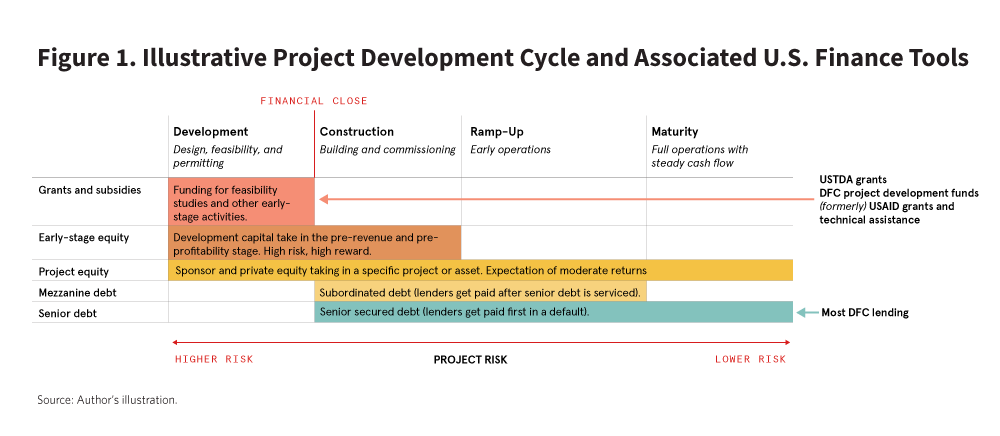
But long before qualifying for serious consideration by the DFC or other traditional development or commercial financiers, an energy project must achieve a large number of costly and time-consuming milestones, including completing project design; conducting feasibility studies and environmental assessments; securing necessary permits and approvals; signing agreements with a utility or other consumer to purchase the electricity they expect to generate; and lining up other public and commercial financiers interested in supporting the project. In emerging markets, very few projects get that far. Less than 10 percent of infrastructure projects in Africa reach financial close, and about 80 percent fail at the feasibility and business planning stage.12 By focusing its interventions on projects that have already navigated those hurdles, the DFC dramatically narrows its window for impact.
The U.S. government does provide some grant capital to help companies pay for early-stage project preparation, primarily through the DFC’s project development funds and funding from the U.S. Trade and Development Agency (USTDA) for feasibility studies. But the scale of this assistance is very limited. For fiscal years 2020–2025, the USTDA supported a total of sixty feasibility studies in the power sector globally, obligating an average of just $14.4 million each year.13 In fiscal year 2024, the DFC obligated $11.7 million toward project development assistance in the power sector, supporting just five projects. And the U.S. Agency for International Development (USAID)—which historically provided a range of grants and technical assistance to firms for early-stage development, business planning, and innovation—no longer exists.
Even when viable, well-prepared energy projects do qualify for late-stage U.S. assistance, onerous and costly project-level reviews and approval processes significantly slow down support and make the United States a less appealing partner. In interviews she conducted with former U.S. officials, Afreen Akhter and the Carnegie Endowment for International Peace found that unjustified delays consistently ranked among the DFC’s primary challenges. For example, officials reported that the DFC had to conduct project-level assessments again, even when IFC-aligned reviews had already been conducted by peer institutions, sometimes multiple times.14 The sluggishness of U.S. support has three primary impacts: It imposes a de facto cap on the overall scale of U.S. investment. It disincentivizes developers and U.S. government officials from pursuing funding for projects that are relatively small, though these are exactly the projects most relevant in emerging markets. And in an era of great power competition, it puts not only the DFC but all Western development financiers at a disadvantage. In 2008, Senegalese president Abdoulaye Wade noted that “a contract that would take five years to discuss, negotiate and sign with the World Bank takes three months when we have dealt with Chinese authorities.”15
Modernizing the U.S. development finance approach does not require intensive legislative action or a wholesale reinvention of policy. Broadly speaking, the financing tools and statutory authorities already available to the U.S. government are sufficient to drive transformative investments. But the way the United States has traditionally deployed them no longer fits the problem it needs to solve.
To build a diversified pipeline of high-quality energy projects, the U.S. government should innovate along three axes:
There is bipartisan political support for increasing the U.S. government’s risk tolerance in making overseas investments. The DFC’s 2025 congressional reauthorization gave its chief risk officer a new mandate to recommend ways to increase risk tolerance, particularly “to undertake projects in less developed countries and in sectors that are critical to development but less likely to deliver substantial financial returns.”16 But what should that look like in the energy sector?
Both the USTDA and the DFC currently provide early-stage project support in the form of grant capital. This approach works fine for the companies that receive the funding, but it creates limited incentives to deploy technical assistance funds, since a grant provides no potential payout. In a U.S. political context with limited support for deploying grant capital overseas, it also curbs the overall scale of support that can be provided.
Instead, the DFC should deploy early-stage support like an investment, incentivizing its staff to seek out promising early-stage projects and companies. This is analogous to venture capital investing, something U.S. capital markets are quite good at. One potential model DFC could implement is a financing mechanism called the simple agreement for future equity (SAFE), created by Y Combinator to help early-stage startups raise capital. The DFC would provide early-stage capital upfront in exchange for the right to convert that investment into company stock at a reduced price in a future trigger event, such as a later funding round. For the project sponsor, this would provide crucial debt-free capital during the early pre-revenue stages of project development. And for the DFC, it would transform early-stage support into an opportunity for significant payout—making it more interesting to staff, and more politically viable.
This mechanism is already being deployed in the development finance context by Elemental Impact, which created the D-SAFE tool to unlock early-stage funding and reduce risk for first-of-a-kind and early commercial projects in climate tech and clean energy.17 It includes a redemption clause that allows it to operate either like a loan at the company’s option or a conversion clause that converts to equity, like a traditional SAFE. As of August 2026, the DFC is exploring this type of solution, though it has not yet been fully developed or implemented.18
Currently, the DFC does not officially provide concessional capital, even in poor countries. Like other development finance institutions, it operates on near-commercial terms in an effort to avoid distorting markets and displacing private lenders. The interest rates on its loans generally comprise base rate, typically either the applicable U.S. Treasury rate or the secured overnight financing rate (SOFR), plus a risk premium calculated on a commercial basis. Many of the driving forces behind this approach are historical and cultural, rather than statutory. The DFC’s predecessor agency, the Overseas Private Investment Corporation (OPIC), repeatedly faced public criticism and congressional calls for its dissolution from those arguing that it distorted private markets. And Congress required OPIC to operate on a self-sustaining basis, with revenues exceeding costs each year.19 Over time, these factors fostered an institutional culture of excessive caution and continue to constrain the DFC’s appetite to take on riskier projects or markets, even though the statutory requirement to exceed its costs no longer exists.20
Given the growing congressional and executive appetite for strategic risk, the DFC should consider creating a dedicated concessional finance window to support high-risk, high-impact projects with financing well below market rate. In the energy sector, this could include first-of-a-kind and early-stage projects. A dedicated concessional window would free the agency to pursue riskier projects by reducing the pressure to earn commercial returns. It could also help resolve the primary political debate that surfaced during the DFC’s congressional reauthorization: Should the corporation invest for global economic development or to achieve American foreign policy objectives and profitable returns? Carving out a concessional window would help guarantee it can do both. There is precedent within the U.S. government for this approach: The U.S. Export-Import Bank’s China and Transformational Exports Program creates a special window for streamlined service, as well as expanded financing tools and flexibility to support exporters facing Chinese competition in ten strategic sectors.21
There are three major reasons why the U.S. government should look for opportunities to delegate key elements of its project origination process to external parties:
The U.S. government should prioritize opportunities to work with seasoned, specialized private investors to accelerate project origination. Increasingly, the second Trump administration has taken this approach, creating models that future administrations could build on. One recent example is the U.S. government’s partnership with the mining investment firm Orion Resource Partners. The Orion Critical Mineral Consortium is a bespoke fund designed to invest in strategic critical minerals projects in DFC-eligible markets.24 In this model, the U.S. government provided initial capital, and Orion contributes technical expertise in the minerals sector that the DFC lacks. Rather than taking the typical approach of investing in an existing fund as a limited partner, this joint framework is designed to ensure that investments advance U.S. interests.
The DFC could also set up U.S. government–owned development companies to originate energy projects. For example, it could partner with energy-focused venture capital firms that could conduct some of the earlier-stage investing that requires more technical knowledge and prioritize smaller projects with ticket sizes too small for the DFC. The U.S. government could design the parameters under which capital could be deployed, as well as a framework for prioritization, standards, and decisionmaking, but would otherwise get out of the way. This would require no statutory change: Its 2025 congressional reauthorization granted the DFC the ability to administer and manage “special projects,” including “by creating companies, corporations, and partnerships that advance both the development objectives and foreign policy interests” of the legislation.25 The DFC is currently exploring such a partnership with the government of Armenia to create a joint venture to develop infrastructure for a transit corridor, including electricity transmission.26
In addition to lending capital to specific stand-alone projects, the DFC should prioritize opportunities to provide corporate loans to trusted companies engaged in markets and sectors it deems highly strategic. This would help the company conduct the early-stage project development activities that would enable it to build a diversified portfolio of projects. Again, the second Trump administration has begun deploying this option more aggressively. For example, the DFC is currently considering a corporate loan for the development, construction, commissioning, and operation of multiple electricity generation and distribution projects in Greece and Romania.27
Ideally, this approach would also reduce the project-by-project review burden on the DFC itself, thereby improving efficiency. In practice, this means the DFC would evaluate the company’s ability to deliver on all aspects of project development—technical, commercial, environmental, and social—but would not review every detail of every potential project.
Finally, for all the attention paid to private sector mobilization in development finance, more than 80 percent of energy infrastructure in developing markets is public.28 So, a strategy like that currently employed by the United States, which focuses almost exclusively on investing in private-sector transactions, omits by definition the vast majority of energy infrastructure deals. Importantly, this includes most of the foundational energy infrastructure that enables follow-on investment by the private sector in new power generation, including distribution and transmission grids. In many lower-income countries, the binding constraint on private investment in energy is the adequacy of public infrastructure, particularly electricity grids and utilities.29 This is an area in which the U.S. government is underequipped to provide support—especially now that USAID, which provided a broad range of technical assistance aimed at strengthening developing countries’ energy sectors, has been dismantled. This new era demands a narrower approach, focused on the technical support best positioned to enable follow-on investment: procurement reform and design.
In the DFC’s reauthorization legislation, Congress required the agency to develop policies and guidelines to support projects “involving a state-owned enterprise, sovereign wealth fund, or a parastatal entity,” opening the door to investments in public assets and companies, but no such DFC policy has yet been made public.30 The DFC’s board should prioritize establishing a clear process and guiding policy for when the agency will invest in sovereign- and subsovereign-owned energy infrastructure, including electric grids, hydropower dams, and nuclear power. This policy should consider special pathways to fast-track projects that would expand the pipeline of viable private sector–led projects, particularly in lower-income countries where much infrastructure is publicly owned.
Providing financial support to governments and state-owned enterprises will broaden the United States’ ability to shape priority investments and accelerate the enabling infrastructure—particularly modern grid systems—that will unlock follow-on private investment in new power generation. It will also enable the United States to operate on a level playing field with its peers. Other advanced economies already provide financial support to sovereign entities in developing economies for energy investment. For example, Australia’s Infrastructure Financing Facility for the Pacific provided a loan and grant package to the government of the Solomon Islands to support hydropower projects that would deliver cheaper and more reliable electricity.31 And Japan’s Bank for International Cooperation extended a loan to India’s state-owned hydropower company and established a credit line for India’s state-owned Power Finance Corporation to fund renewables, next-generation energy, and efficiency.32
The MCC is relatively small, with a budget of $830 million in fiscal year 2026.33 But it has a unique ability within the U.S. government to fund the public energy infrastructure that needs to exist before private firms can invest in new power generation or cleaner technologies. This makes it a hugely impactful, but underappreciated, contributor to unlocking follow-on energy investment and impact. For example, the MCC’s Senegal Power Compact dedicates $364 million to strengthening the reliability of Senegal’s high-voltage transmission network so it can absorb the private sector’s interest in funding new generation projects in wind, solar, and natural gas.34
During the second Trump administration, the MCC’s dedication to transparency and good governance has helped protect its long-standing bipartisan support, even as other parts of U.S. development assistance were downsized or dismantled. Since undergoing the Trump administration’s foreign assistance review, the agency’s portfolio has become predominantly focused on the energy sector. This creates a politically viable opportunity to scale up the agency’s energy interventions and impact. The administration should work with Congress to roughly double the MCC’s energy portfolio, with an expanded focus on energy infrastructure investments that have the greatest potential to unlock follow-on opportunities for the DFC and other investors, including local firms.
To scale energy investment in developing markets, the U.S. government does not need to recreate the full suite of technical assistance once provided by USAID. Instead, relevant U.S. agencies should focus more narrowly on working with key government partners in foreign markets to design and operationalize competitive procurement structures for energy generation.
Specifically, the United States should focus on two things. The USTDA and the State Department should work with foreign government partners to design procurement policies that take into account life cycle costs and performance, thereby putting U.S. bidders on a more level playing field with foreign competitors. Energy and critical infrastructure security expert Steven Burns estimated that providing U.S. technical assistance for procurement modernization in ten to twelve countries would give U.S. firms a chance to compete for tens of billions of dollars in tenders, potentially $20–$30 billion over five years, based on the typical annual infrastructure procurement volumes of major emerging markets in Africa, Southeast Asia, and Latin America.35 The approach can build on the USTDA’s Global Procurement Initiative and the technical assistance that USAID once provided.
Second, the United States should work with allied financiers and local reform-minded policymakers to ensure that countries negotiate power purchase agreements with independent power producers competitively and transparently, thereby reducing risks, accelerating procurement, and lowering costs.36 Transparency standards for electricity contracts with public entities, like those that already exist for contracts in the oil and gas sector, are a no-cost way of further liberalizing emerging markets in which energy needs to be procured much faster and at lower costs.
The broad, politically diverse support for U.S. investment in energy infrastructure across emerging markets creates an opening to build a foreign policy that is durable, economically transformative for America’s foreign partners, and aligned with broader U.S. goals and interests. In an era that has upended traditional development policies, institutions, and expectations—and in which energy security is an increasingly significant driver of diplomacy, economics, and national security—the United States has a chance to reinvent its development finance strategy to be bolder, more ambitious, and more effective.

Nonresident Scholar, Africa Program
Katie Auth is a nonresident scholar with the Carnegie Endowment for International Peace’s Africa Program.
Recent Work


Zainab Usman, Anthony Carroll, Saskia Holman, …
Carnegie does not take institutional positions on public policy issues; the views represented herein are those of the author(s) and do not necessarily reflect the views of Carnegie, its staff, or its trustees.
President Tshisekedi is implicating Washington in his pursuit of a third term. Staying silent may prove detrimental to the United States in the long run.

Christian-Géraud Neema

To carry out its global AI agenda, Washington will need strategic relationships with emerging markets in Africa, starting with Kenya.

Jane Munga
Washington’s transactional foreign policy is making it indistinguishable from Beijing’s, with consequential implications for African agency.
Jane Munga
The impacts of the Faye-Sonko rupture could go well beyond the country’s borders.

Lesley Anne Warner
Strengthening U.S.-Africa trade and advancing U.S. interests aren’t conflicting goals.


Tyler Beckelman, Kholofelo Kugler